Enterprise AI · Multimodal Interaction · Multi-Agent Systems
FedEx AI Concierge Experience
How might enterprise users configure complex AI workflows using natural conversation, voice, and structured controls while maintaining transparency, trust, and control?
Designing a multimodal interaction model where natural language becomes structured enterprise configuration—without sacrificing human oversight.
I designed the interaction foundation for FedEx AI Concierge: multimodal input, intent translation, human-in-the-loop control, and reusable AI patterns later used by the Sierra AI team.
Role
AI Product Designer
Company
FedEx Dataworks
Focus
Multimodal AI, Intent Translation, Multi-Agent Orchestration, Enterprise Trust
Status
Shipped foundation / adopted internally
The opportunity
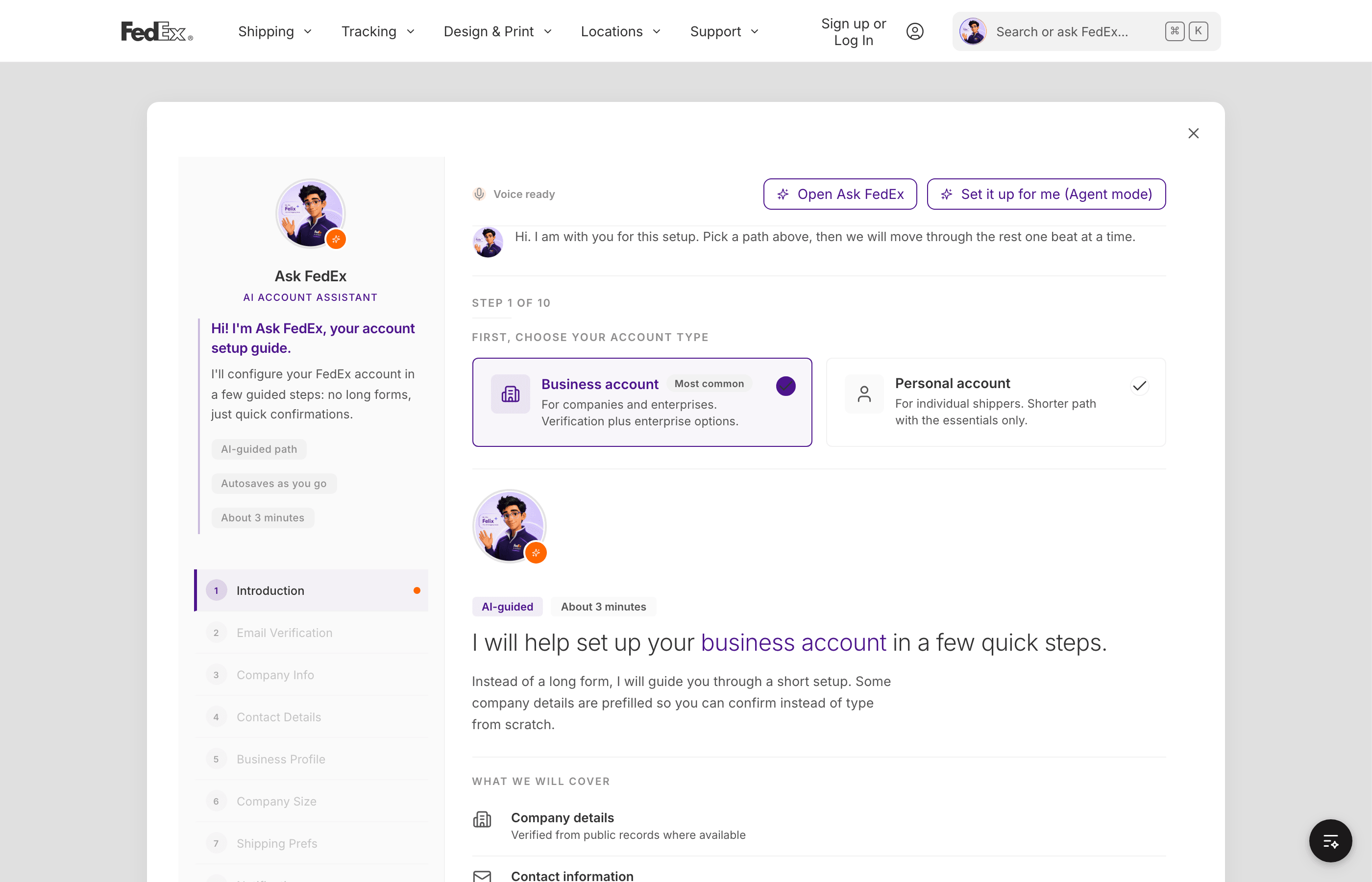
Enterprise AI systems ask users to configure workflows that used to live in forms, tickets, and tribal knowledge. Natural language makes that configuration faster—but only if the system can translate intent into structured decisions that operators can inspect, edit, and trust.
The opportunity was not to design a chatbot. It was to design the interaction layer between human intent and machine orchestration.
Why enterprise AI onboarding is different
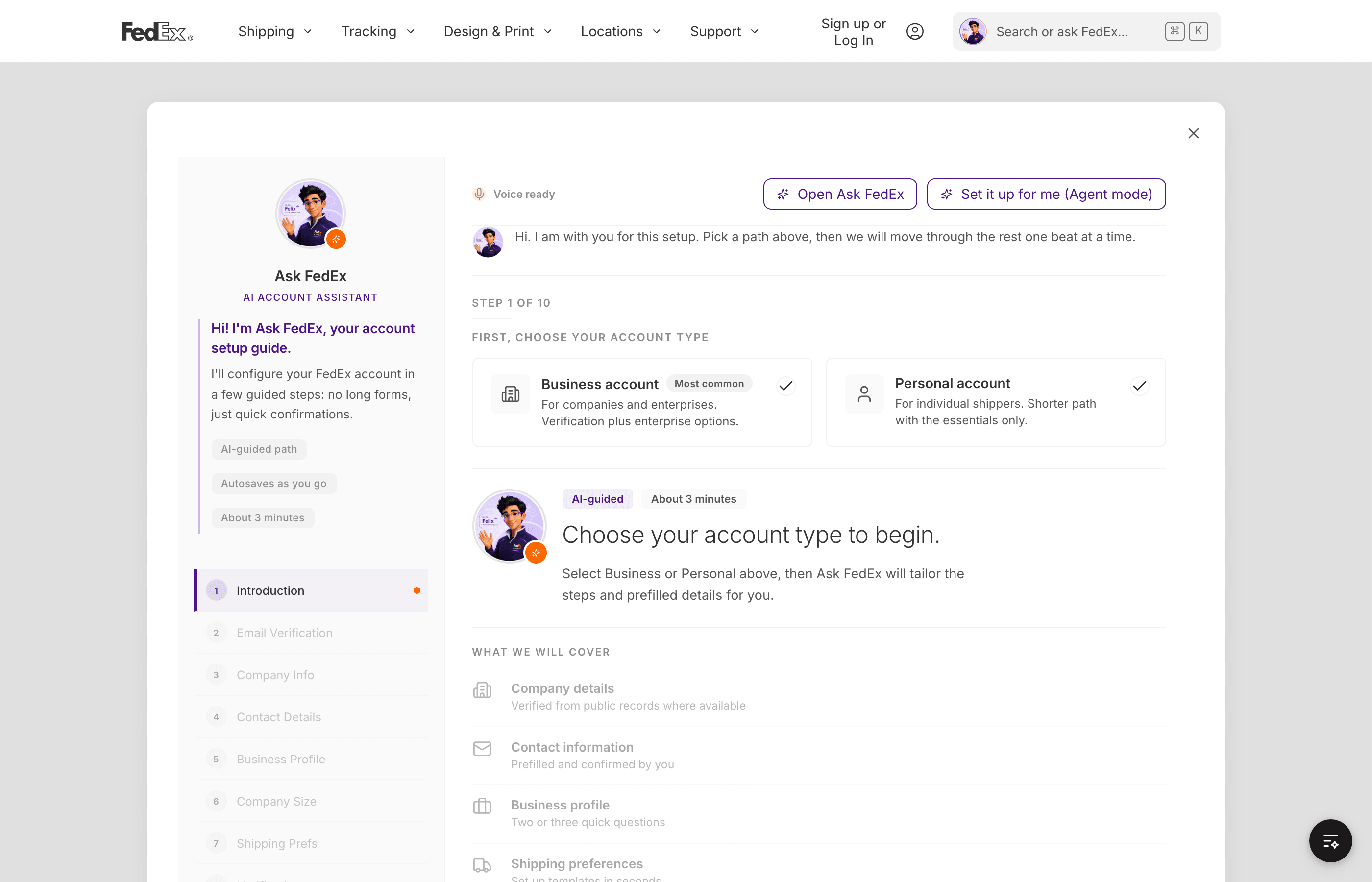
Traditional product onboarding teaches navigation. Enterprise AI onboarding teaches a mental model: what the system can do, how it reasons, where agency sits, and when a human must intervene.
Learn where features live
Learn what the system can and cannot decide
Complete a setup checklist
Express intent and review machine interpretation
Configure static settings
Author workflows that agents will execute
Trust comes from familiarity
Trust comes from transparency and control
The first experience had to establish that contract—before users could rely on AI for operational work.
Design principles
Conversation proposes. Structure confirms.
Natural language accelerates intent capture. Structured UI makes every decision visible and editable.
One face, many capabilities.
Users work with a coherent partner. Multi-agent orchestration stays behind a single interaction model.
Reveal complexity when it earns trust.
Progressive disclosure surfaces reasoning, handoffs, and constraints only when they help users act with confidence.
Human control is a primary path.
Correction, override, and approval are not edge cases. They are core interaction patterns.
Design the reusable language.
Status, handoff, waiting, explanation, and recovery must scale across agents and products.
Multimodal interaction model
Users should not choose between speaking, typing, and clicking. Each modality has a job—and the system should let them move freely between fluid expression and precise control.
Voice
Capture intent quickly when context is spoken, situational, or faster than typing.
Chat
Clarify ambiguity, ask follow-ups, and keep a durable record of the exchange.
Structured UI
Inspect fields, constraints, permissions, and configuration states with full editability.
Interaction loop
01
Express
User states a goal in voice or chat
02
Interpret
System proposes structured understanding
03
Inspect
User reviews editable configuration
04
Confirm
Human approves before execution
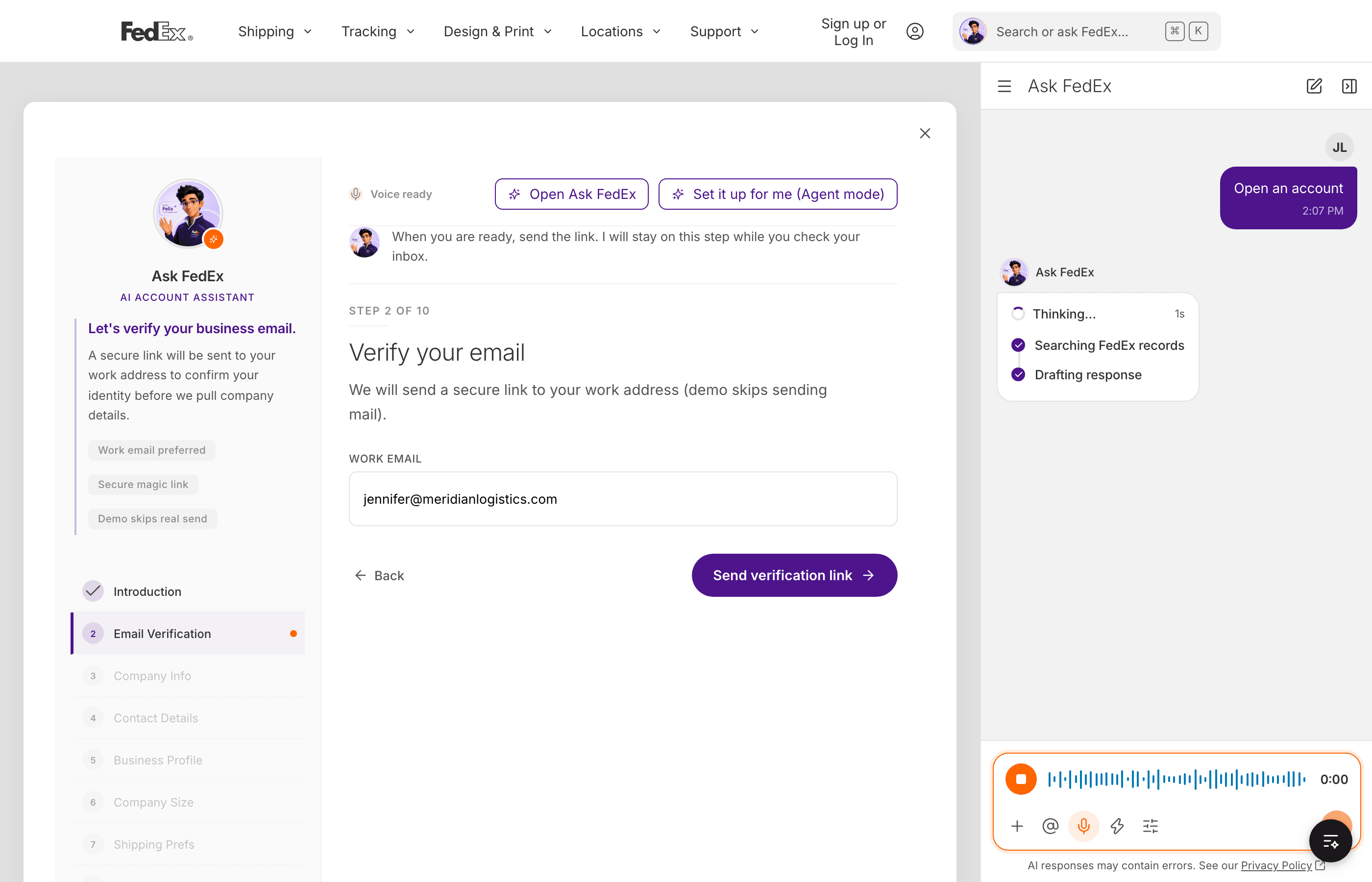
Modalities share one state. Switching channels never restarts the work.
Voice + structured UI
Voice alone is too opaque for enterprise configuration. Forms alone are too slow for complex intent. The design couples them.
Speech and chat open the workflow. Structured controls close it. The AI drafts a configuration object; the interface exposes that object as something a person can verify field by field—without forcing them to rebuild it from scratch.
01
Speak the goal
“Set up routing for exception handling across these lanes.”
02
See the interpretation
Goals become parameters, constraints, and proposed agent responsibilities.
03
Edit with precision
Operators adjust values, permissions, and escalation paths in structured controls.
04
Return to conversation
Ambiguity or exceptions can be resolved in chat without leaving the configuration context.
Intent translation
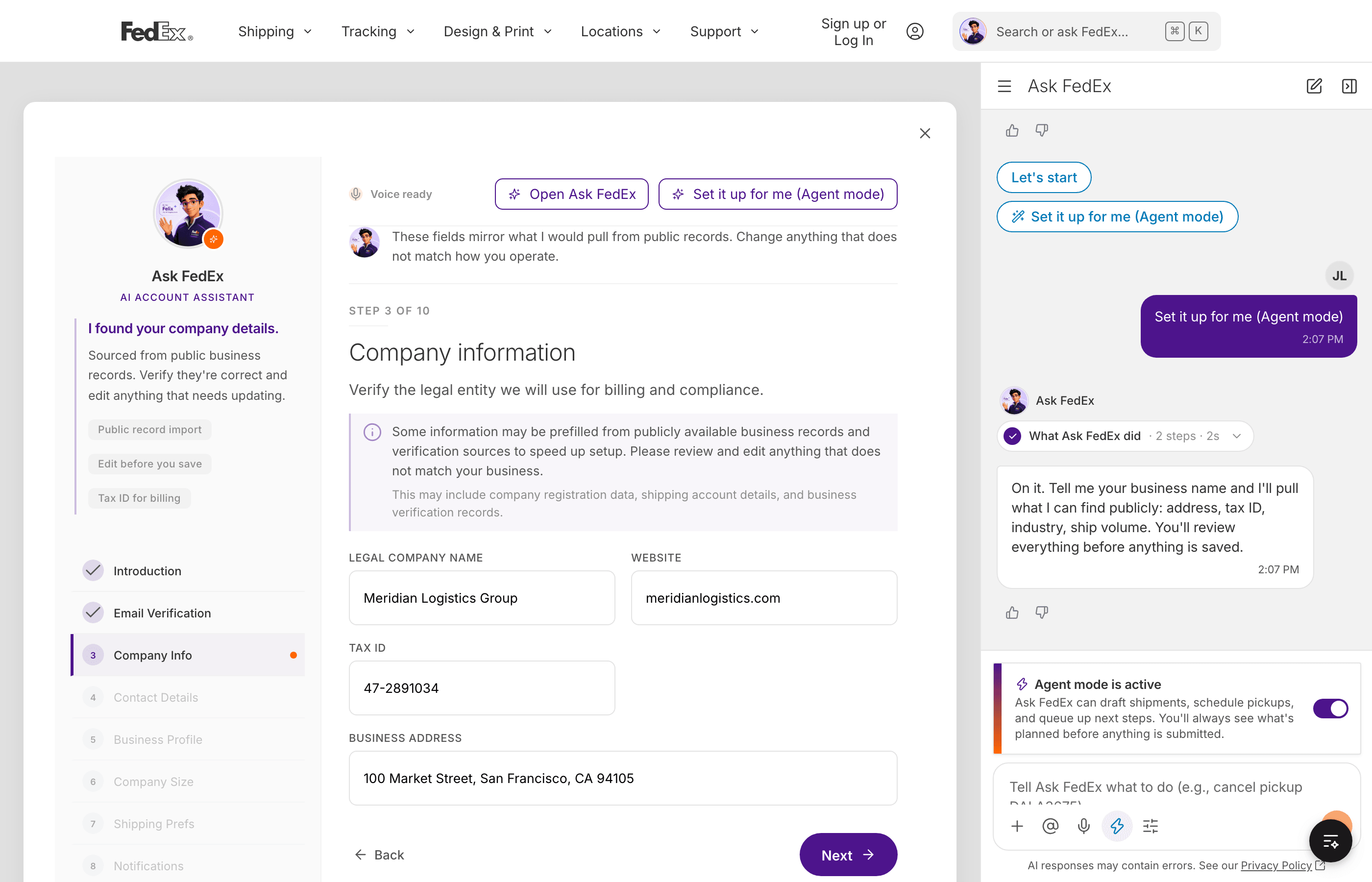
The core system behavior is translation: turning natural language into enterprise-ready configuration while keeping every inference inspectable.
01
Raw intent
What the user said or typed
02
Interpreted goal
Normalized objective and scope
03
Structured draft
Fields, constraints, and agent responsibilities
04
Human review
Edits, approvals, and withheld actions
05
Executable plan
Configuration ready for orchestration
Nothing becomes operational until the human-readable draft is accepted.
Felix AI as an onboarding partner
Felix is not a tour guide. It is an AI partner that helps users author their first meaningful workflow—teaching the system by doing real work.
Instead of walking through feature lists, Felix helps users express intent, draft configuration, surface uncertainty, and invite correction. The first session establishes the operating contract: the AI proposes; the human decides.
- Guide users into a first real configuration task
- Translate conversational intent into structured drafts
- Reveal uncertainty and ask for missing enterprise context
- Keep orchestration coherent across specialized agents
- Preserve clear points for human review and control
Users perceive one partner. The system coordinates capabilities behind that relationship.
Reusable AI patterns
The interaction language was designed to outlive a single flow—so other teams could reuse the same signals for trust, status, and control.
Intent capture
Collect goals through voice or chat without forcing premature form fill.
Interpretation preview
Show how the system understood the request before acting.
Editable configuration
Expose AI drafts as structured, human-owned controls.
Uncertainty prompt
Ask for missing context instead of guessing silently.
Agent status
Communicate active work without exposing system noise.
Handoff
Signal when specialized capabilities take over a step.
Progress and waiting
Keep long-running orchestration legible and trustworthy.
Explainability
Surface enough reasoning for operators to judge outcomes.
Human override
Make correction and intervention a primary path.
Permissions and consent
Keep access requests scoped, explicit, and reviewable.
AI-native design system
Alongside the product experience, I led the evolution of an AI-ready enterprise design system—tokens, components, semantic metadata, and implementation guidance that helped teams ship consistent AI interfaces at scale.
The Concierge interaction patterns became a foundation used by the Sierra AI team at FedEx. The machine-readable system enabled AI-assisted implementation across product delivery.
12
Product teams
200+
Designers
35%
Faster design-to-code handoff
Design foundation
Tokens, components, interaction standards, and reusable AI patterns
Machine-readable documentation
Semantic metadata, behavioral constraints, and implementation guidance
AI-assisted delivery
Structured design-system knowledge that enabled AI coding tools to support implementation
[AI-native design system: Figma → semantic metadata → coded components → AI-assisted implementation]
Conceptual architecture placeholder
Reflection
- 01
Enterprise AI design is less about screens and more about the contract between human intent and machine action.
- 02
Multimodal interfaces work when modalities share state—voice, chat, and structured controls must describe the same underlying configuration.
- 03
Trust scales when interpretation is visible: users need to see what the system understood before they allow it to act.
- 04
The durable output of AI product design is often the pattern language and design infrastructure that other teams inherit.
Next project
Atlas — AI-Native Design System
A machine-readable design system and reusable interaction framework for humans and AI agents.
← Back to work