Featured · Built at Dell × NVIDIA Local AI Hackathon
LocalPMOS
The Company Brain for Autonomous Software Teams
Built in two days at the Dell × NVIDIA Local AI Hackathon, LocalPMOS is an AI-native operating system that continuously captures organizational context, identifies risks, prioritizes work, and converts decisions into executable actions.
Role
AI Product Design, AI Engineering, Product Strategy
Timeline
2 days
Built at
Dell × NVIDIA Local AI Hackathon
Hardware
Dell Pro Max with NVIDIA GB10
Core system
Local AI, memory, product intelligence, workflow orchestration
Outcome
Working end-to-end prototype · Local AI inference · Multi-agent workflow · Real reminder generation
Overview
Modern software teams generate thousands of signals every day across Slack, GitHub, Jira, customer feedback, documentation, meetings, and AI-generated artifacts. Yet no system understands this context as a whole.
LocalPMOS explores a different approach: an AI operating system that continuously builds organizational memory, reasons across company knowledge, and converts insights into real actions.
The problem
Product managers, engineers, founders, and operators spend hours every week gathering context before they can make decisions.
Critical information is fragmented across Slack, GitHub, Jira, docs, customer feedback, meetings, dashboards, and email.
Teams struggle to:
• Understand what changed across tools • Connect customer feedback to roadmap decisions • Identify launch risks before they become blockers • Prioritize work with incomplete context • Preserve institutional memory across projects and team changes • Turn decisions into follow-up actions
The problem is not a lack of tools. The problem is that no system understands the full context of the business.
From assistant to operator
Unlike traditional AI assistants that wait for questions, LocalPMOS acts as an operator. It continuously monitors company context, identifies risks and opportunities, prioritizes work, and converts recommendations into executable actions.
Product workflow
Collect context
Slack · GitHub · Jira · Docs · Email · Customer feedback
Reason
Analyze company state and detect risks
Prioritize
Identify decisions, blockers, and next steps
Recommend
Generate product recommendations, PRDs, Jira tickets, and stakeholder updates
Execute
Create reminders, tasks, follow-ups, and operational outputs
My role
I worked across product strategy, AI workflow design, system architecture, multi-agent UX, information architecture, frontend implementation, demo planning, and presentation.
- Defined the product vision around organizational memory and autonomous product workflows
- Designed the core AI operating-system metaphor
- Mapped the workflow from company context → reasoning → decision → task → real-world follow-up
- Shaped the multi-agent UX for briefing, recommendations, context, and execution
- Helped design the local-first architecture for privacy-sensitive company knowledge
- Built and refined the prototype experience under a two-day hackathon constraint
- Created the demo narrative showing AI moving beyond analysis into execution
Key product decisions
Local-first by design
Company context is sensitive. LocalPMOS explores how product intelligence can run close to the organization's data instead of sending every workflow to external systems.
Continuous over chat
The product does not wait for a user to ask, "What should we do next?" It continuously observes context and surfaces recommendations proactively.
Memory as infrastructure
The most valuable asset inside a company is accumulated knowledge, decisions, and outcomes. LocalPMOS treats memory as a first-class product layer.
Action over dashboards
The demo moves from analysis into execution by creating real follow-up tasks, showing that agentic products should close the loop between insight and action.
Demo
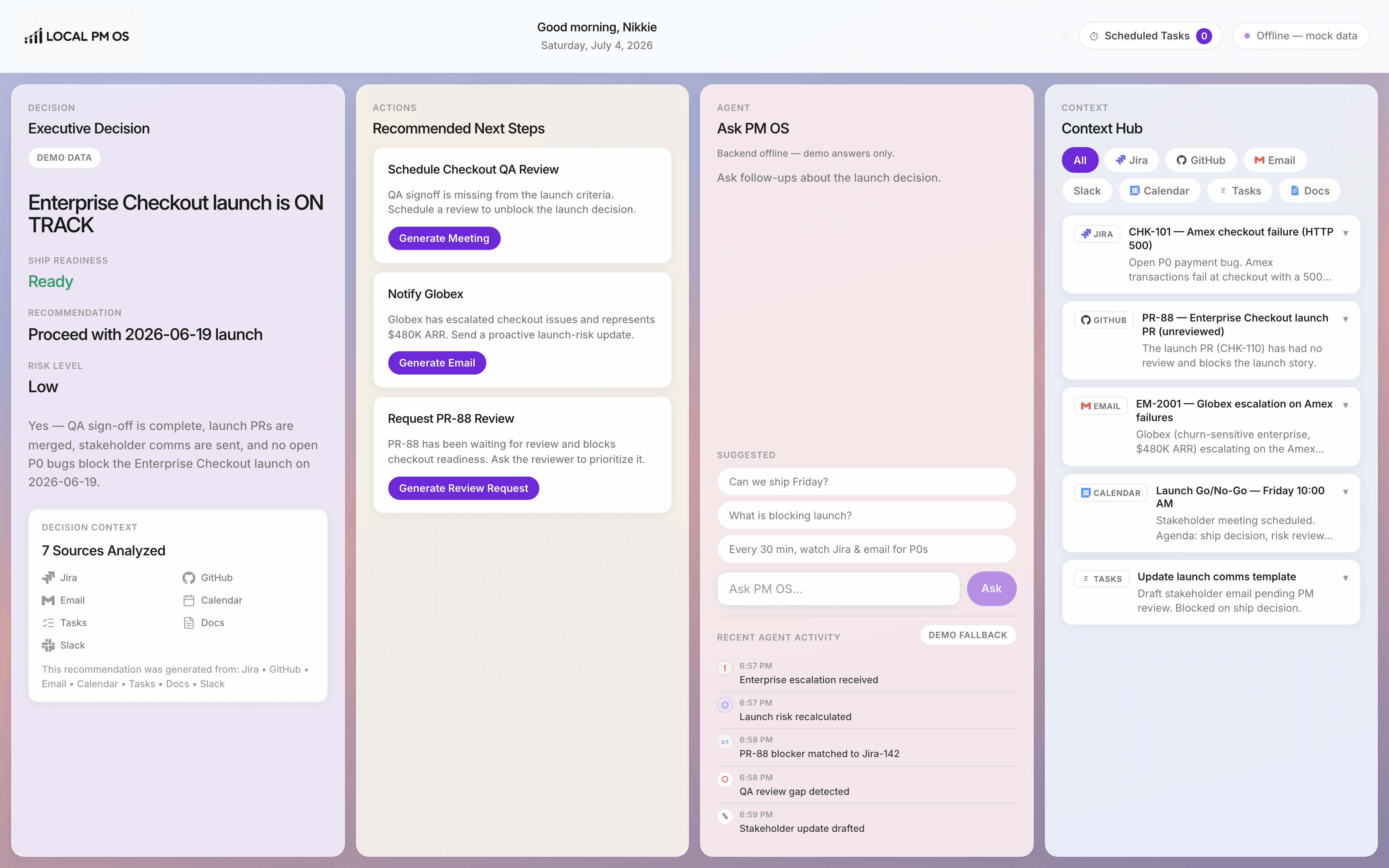
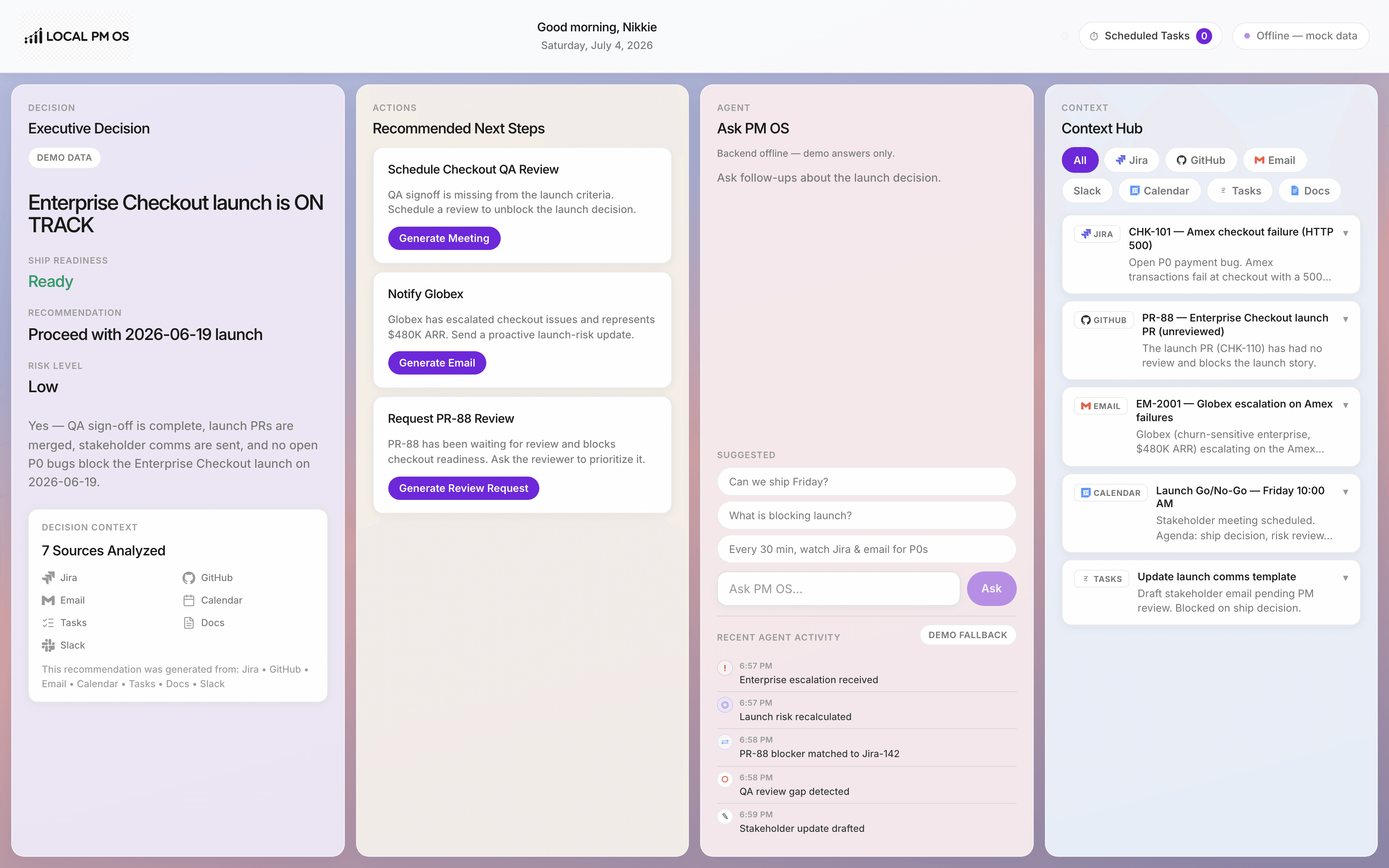
The prototype analyzes project context and identifies a launch-critical decision.
Enterprise Checkout requires a go / no-go decision. The system detects that the launch depends on QA sign-off and zero open P0 issues, then creates an actionable reminder inside Apple Reminders.
Context
→ reasoning
→ decision
→ task
→ real-world follow-up
This proves LocalPMOS is not just a dashboard. It is an operating layer that turns company knowledge into action.
Built live during the Dell × NVIDIA Local AI Hackathon.
Product in practice
Hackathon build session
Screenshot coming soon
Demo day presentation
Screenshot coming soon
System architecture
- Slack · GitHub · Jira · Docs · Email · Customer feedback
- Local knowledge base
- Memory layer
- Context engine
- Reasoning agent
- Planning agent
- Execution agent
- Apple Reminders · Jira tasks · Email updates · Stakeholder summaries
Tech stack
- Next.js
- React
- Python
- NVIDIA NIM
- Local RAG
- Vector Database
- Dell Pro Max with NVIDIA GB10
- Multi-agent orchestration
Challenges
- Designing a system that could reason across fragmented company context
- Keeping the product local-first while still demonstrating a useful AI workflow
- Translating noisy signals into clear product recommendations
- Designing an interface that felt like an operating system rather than another chatbot
- Closing the loop from AI reasoning to actual task execution within a two-day build
Lessons learned
The hardest challenge was not building another AI assistant. It was designing an operating system that remembers context, reasons over time, and takes action.
- Memory is a first-class AI primitive.
- Context quality matters more than model size.
- AI becomes more valuable when it executes, not only when it answers.
- The future AI interface may be less about chat and more about continuous operational awareness.
Future vision
LocalPMOS explores a broader question: what if organizations had persistent memory?
The same architecture could support engineering, recruiting, finance, sales, customer success, operations, and every function that depends on institutional knowledge and decision quality.
Product management is simply the first environment.