2nd Place · YC AI Growth Hackathon
ReadyLead
AI Growth Intelligence for Commercial HVAC
ReadyLead turns scattered public maintenance signals into ranked commercial sales opportunities, helping contractors focus on buildings that show evidence of maintenance needs instead of cold-calling every property.
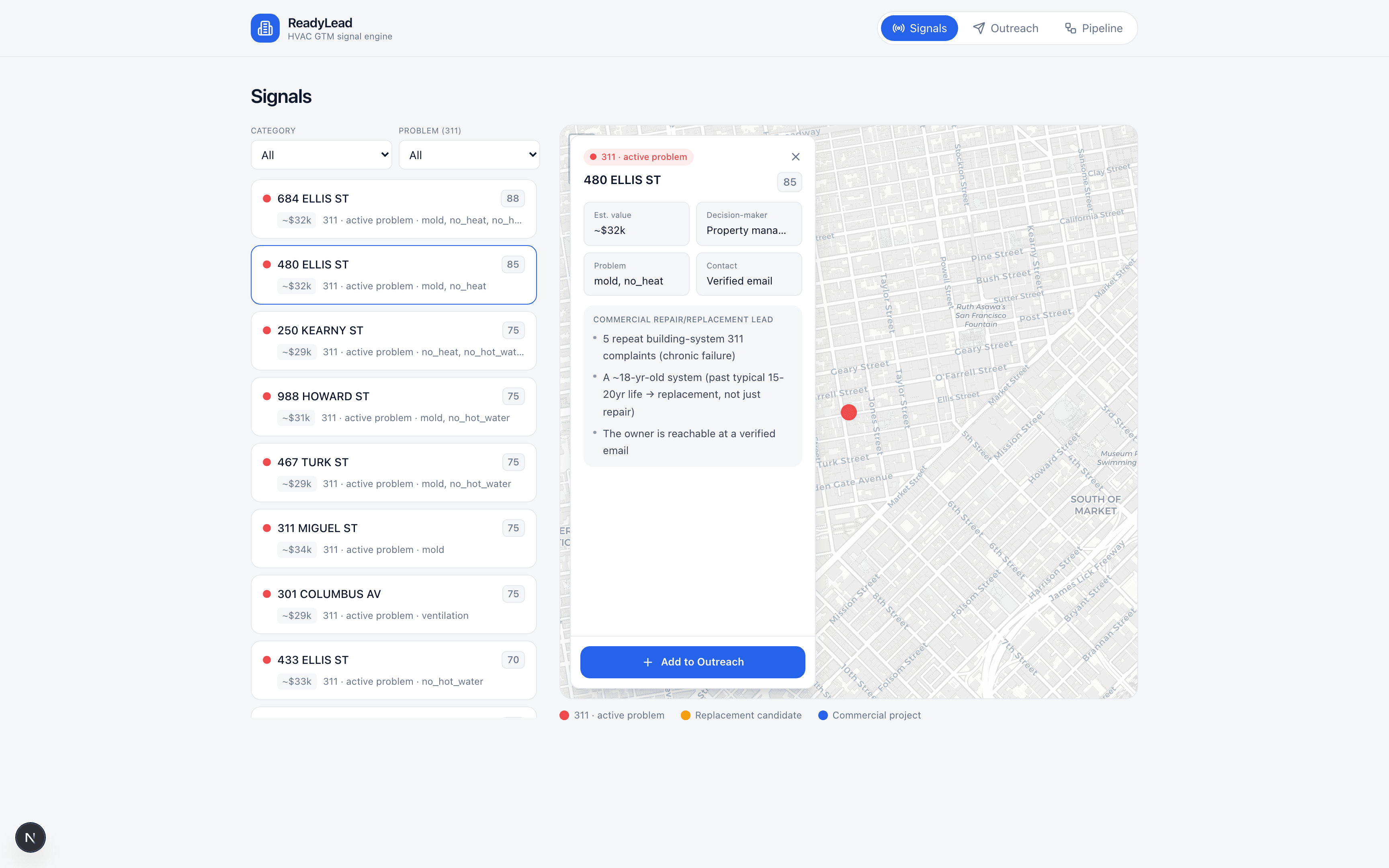
The opportunity
Commercial HVAC contractors spend thousands of dollars every month on Google Ads, referrals, cold outreach, and purchased lead lists. Most sales efforts are reactive, expensive, and poorly targeted.
Cities like San Francisco publish valuable maintenance signals, including 311 complaints, building permits, and public records. These signals can reveal buildings with potential HVAC or maintenance needs, but the data is fragmented, noisy, and impossible to monitor manually.
ReadyLead reframes public infrastructure data as a proactive growth signal for commercial contractors.
From cold outreach to evidence-backed selling
Rather than helping contractors contact more buildings, ReadyLead helps them identify the right buildings. The product thesis is simple: public maintenance activity can become a high-intent commercial signal when AI can collect, reason over, rank, and explain it.
Product workflow
Public maintenance data
Collect San Francisco 311 complaints and public building records.
Building-level analysis
Generate building profiles and identify maintenance indicators.
Opportunity scoring
Use AI reasoning to rank likely commercial opportunities.
Contact path discovery
Find likely property owners, managers, or decision-maker paths.
Contractor matching
Match opportunities to relevant contractors by trade, service area, and need.
Evidence-backed outreach
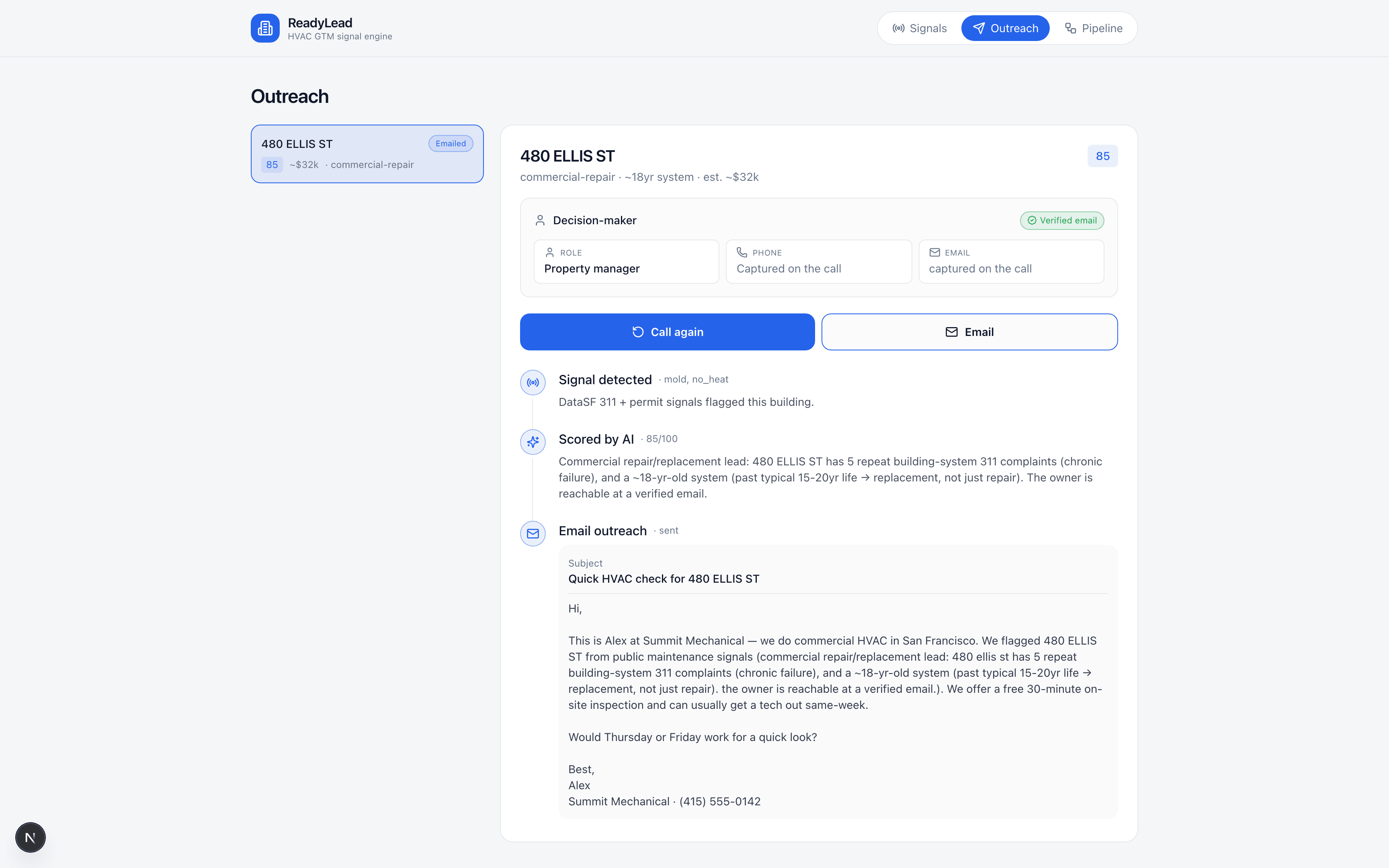
Generate personalized outreach grounded in the public signals.
Voice scheduling
Use a Vapi voice agent to help schedule an inspection.
My role
I worked across product strategy, AI workflow design, UX architecture, interaction design, frontend implementation, product positioning, and the final hackathon pitch.
- Framed the commercial HVAC lead-generation opportunity
- Helped define the end-to-end AI GTM workflow
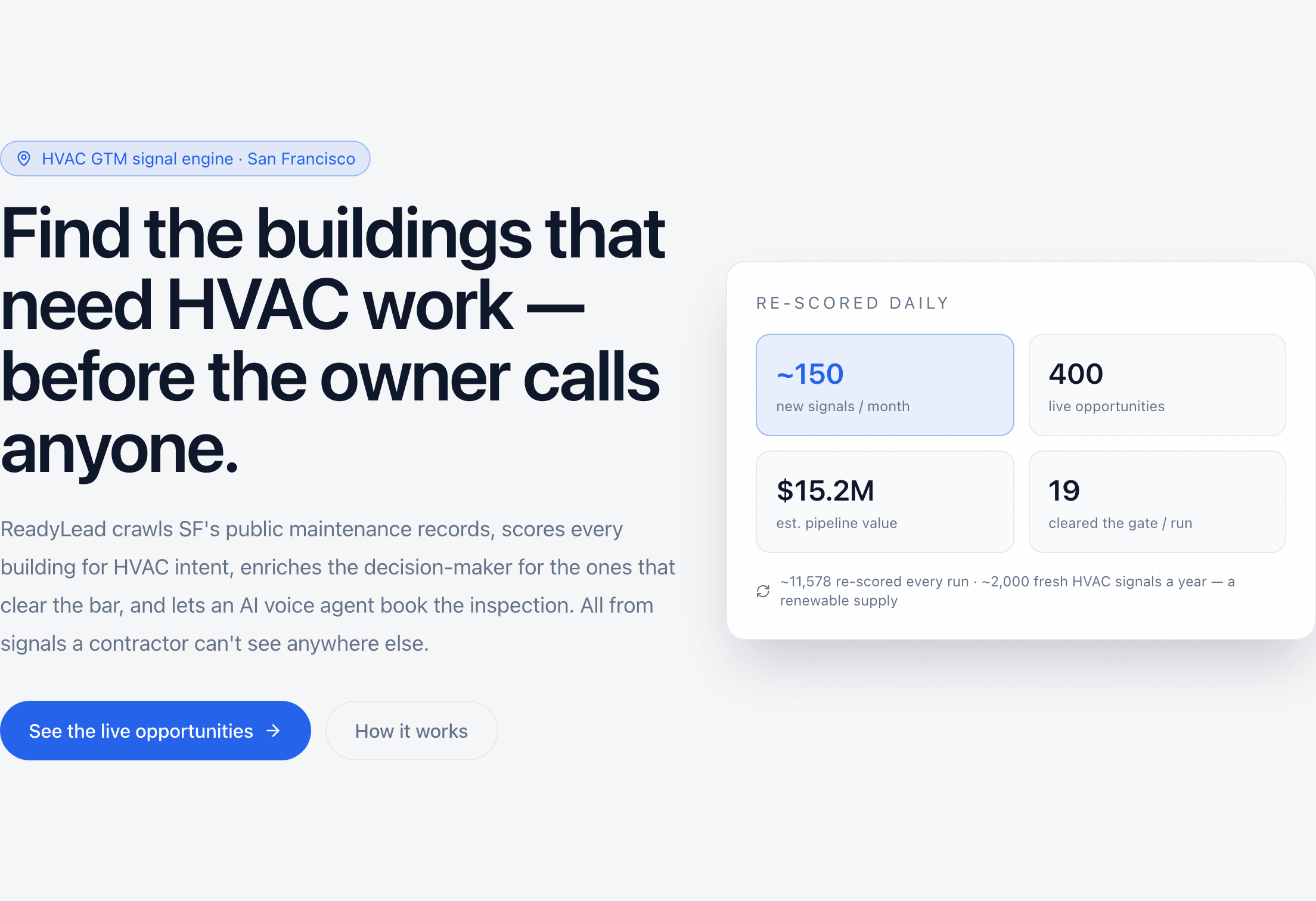
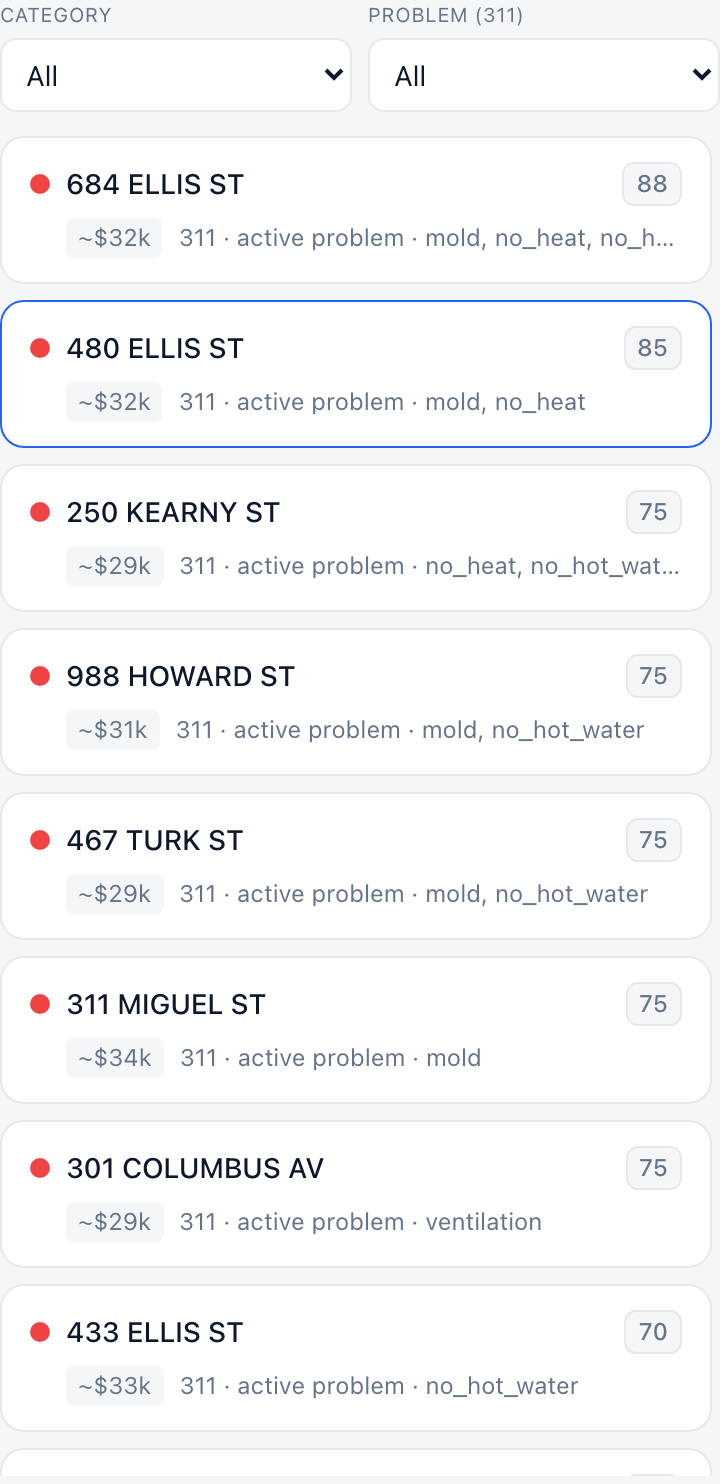
- Designed the core product experience around ranked opportunities
- Shaped the evidence-backed reasoning and outreach flow
- Contributed to the frontend prototype and demo narrative
- Helped translate the product into a clear hackathon pitch
Key product decisions
Prioritize intent over volume
The goal was not to generate more leads. It was to help contractors focus on buildings with visible evidence of maintenance need.
Use public data as commercial signal
311 complaints, permits, and building records create a more timely signal than generic purchased lead lists.
Explain the score
For sales teams to trust AI ranking, the system needs to show why a building is recommended, not just assign a black-box score.
Design for action, not dashboards
The workflow moves from signal to opportunity to outreach to scheduling, so the product supports execution rather than passive analysis.
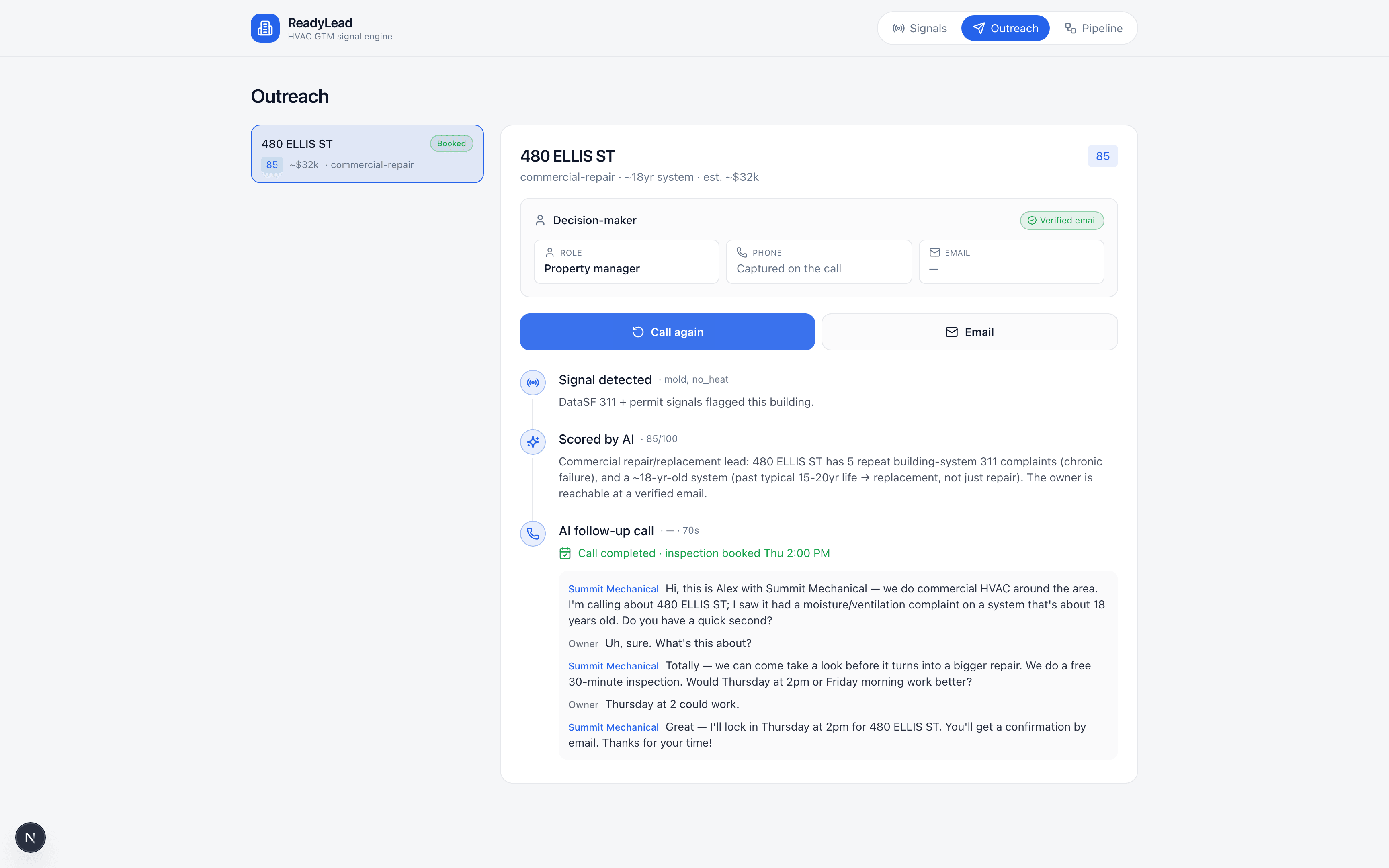
Product in practice
Technical architecture
- Frontend dashboard
- Convex backend
- Public datasets
- OpenAI reasoning layer
- Opportunity scoring
- Outreach generation
- Vapi voice agent
Frontend
Next.js
Backend
Convex
LLM
OpenAI
Voice Agent
Vapi
Data Sources
San Francisco 311 and public building datasets
Development Tools
Cursor / Codex
Challenges
- Combining multiple public datasets into a unified building profile
- Ranking maintenance opportunities while avoiding unsupported predictive claims
- Identifying realistic contact paths for commercial buildings
- Designing an end-to-end agent workflow that could be demonstrated within a hackathon timeframe
What we shipped
The hackathon MVP demonstrated the full ReadyLead workflow using real San Francisco public maintenance data.
- Real public maintenance data
- Thousands of buildings analyzed
- AI-ranked commercial opportunities
- Evidence-backed outreach recommendations
- End-to-end workflow from signal → opportunity → outreach → voice scheduling
Outcome
ReadyLead successfully demonstrated how fragmented public maintenance data can be converted into actionable commercial sales opportunities. The project validated the core thesis that AI can transform noisy public signals into evidence-backed GTM workflows.
Lessons learned
- The strongest growth AI products connect signal detection to actionable workflow, not just dashboards or scores.
- Explainability matters when AI is used to prioritize sales opportunities.
- Hackathon MVPs need clear product judgment: what to automate, what to fake, and what to prove.
Future work
- CRM integrations
- Multi-city expansion
- Memory for account history
- Contractor feedback loops
- Lead scoring evaluation framework
- Multi-agent collaboration for research, scoring, outreach, and scheduling